

US Degrowth Policy: The Basics
An preliminary toolkit for degrowth advocates in the US
About This Document
“US Degrowth Policy: The Basics” introduces degrowth activists and organizers to policy interventions that can help support a degrowth agenda in the United States. Degrowth is an intentional downscaling of the global economy for the purpose of achieving ecological sustainability and social justice. Members of the degrowth movement engage in all kinds of work, from research to advocacy, education to direct action, discussion to grassroots organizing.
This document was put together by the Degrowth Policy Working Group, a project of Degrowth Institute, supported by Leadership for the Ecozoic. The Degrowth Policy Working Group is a volunteer effort, and members hold a range of backgrounds, expertise and perspectives. As such, this document is not intended to be treated as a definitive or final list of degrowth policies. Rather, it is intended as a launching point for deeper conversations and deliberation on degrowth policies and priorities across the US. It is geared towards degrowth activists and enthusiasts in the US looking for ways to tangibly organize around degrowth in their communities.
The Working Group is actively soliciting feedback, critique and commentary on this document. If you are interested in submitting feedback, please fill out the feedback form at the bottom of this page.
Last, this document intentionally does not limit itself to proposals that would likely win an election or pass if put to a vote in the US today. As movement strategists have counseled for generations, it is not the project of a grassroots social movement to limit its goals to what is currently politically viable. It is the goal of a social movement to change what is politically possible through persistent advocacy, education and action [1].
Contents
US Degrowth Policy Goals and Proposals
Removing economic growth as an explicit policy goal, and shifting measures of economic success
Shifting to more ecological, place-based methods of production
Increasing environmental protections and restoring degraded ecosystems
Expanding popular control over the economy and reducing privatization
Reducing the domination of the global economy by US interests
Introduction: Why Degrowth, and Why the US?
The global economy has pushed past most of our planet’s critical boundaries, and climate change is only one of many symptoms [2, 3]. The myriad social and environmental issues we face today (biodiversity loss, land-system change, biogeochemical imbalance, climate change, global wealth inequality, global health inequality, water scarcity, and political tensions over increasingly scarce resources) make it plain that we have exceeded a safe operating space for humanity (Figure 1). It is economic forces that drive our use of natural resources, and it is the structure of our economic system that continues to impede our sustainability efforts [4].
In the US and in many places around the world, the current economic system hinges on the growth imperative: economies that prioritize, and rely on, continued capital growth, and through this, the continued expansion of natural resource use. While growth-based economies have spurred important innovations in medicine and technology, making economic growth a fundamental requirement for economic “success” ignores other goals that are necessary for a population’s wellbeing, such as equity, peace, and human and ecological health, to name only a few.
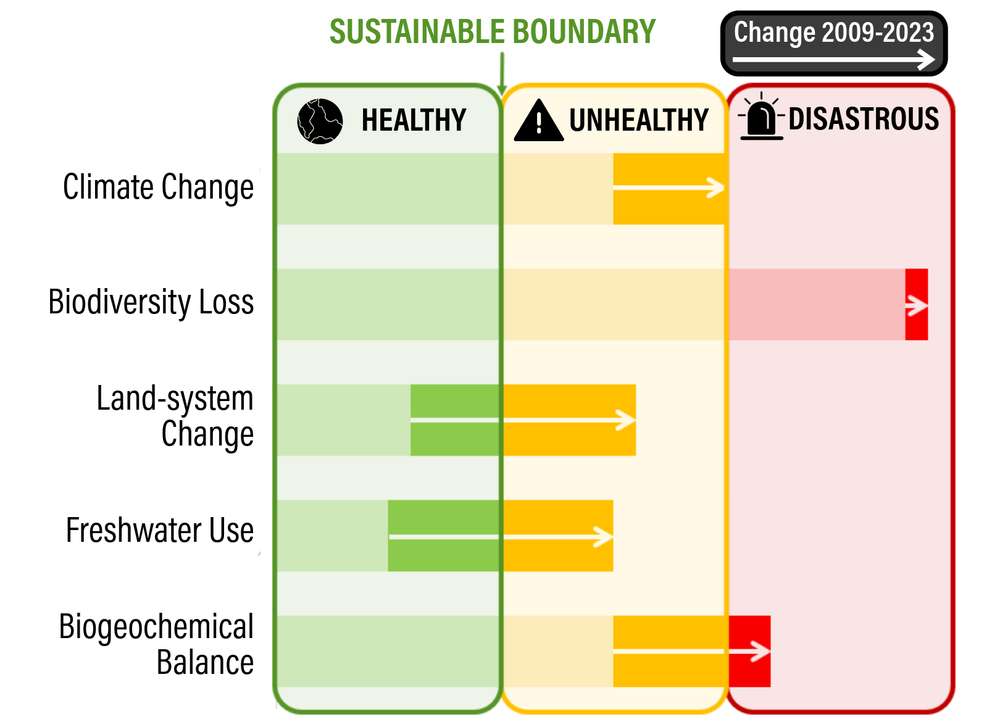
Figure 1
Growth imperative-based economies also typically lead to massive wealth accumulation for a minuscule portion of the population (think 0.1%, or the wealthiest 350,000 people), while still failing to meet the basic needs of the majority. The US is facing critical shortages in areas such as housing, sanitation, energy and healthcare, and our economy consistently struggles to fix these issues, despite having effective solutions and a capable workforce [5].
For the vast majority of people in the US, the endless thirst for economic growth has contributed to a decline in wellbeing, as basic needs (including a safe, healthy environment) continue to go unmet in pursuit of ever-greater profits and ever-increasing extraction. Reducing our economy’s size and levels of consumption, and shifting our economy’s priorities towards social and ecological health, could lead to substantial improvements in wellbeing for people and planet.
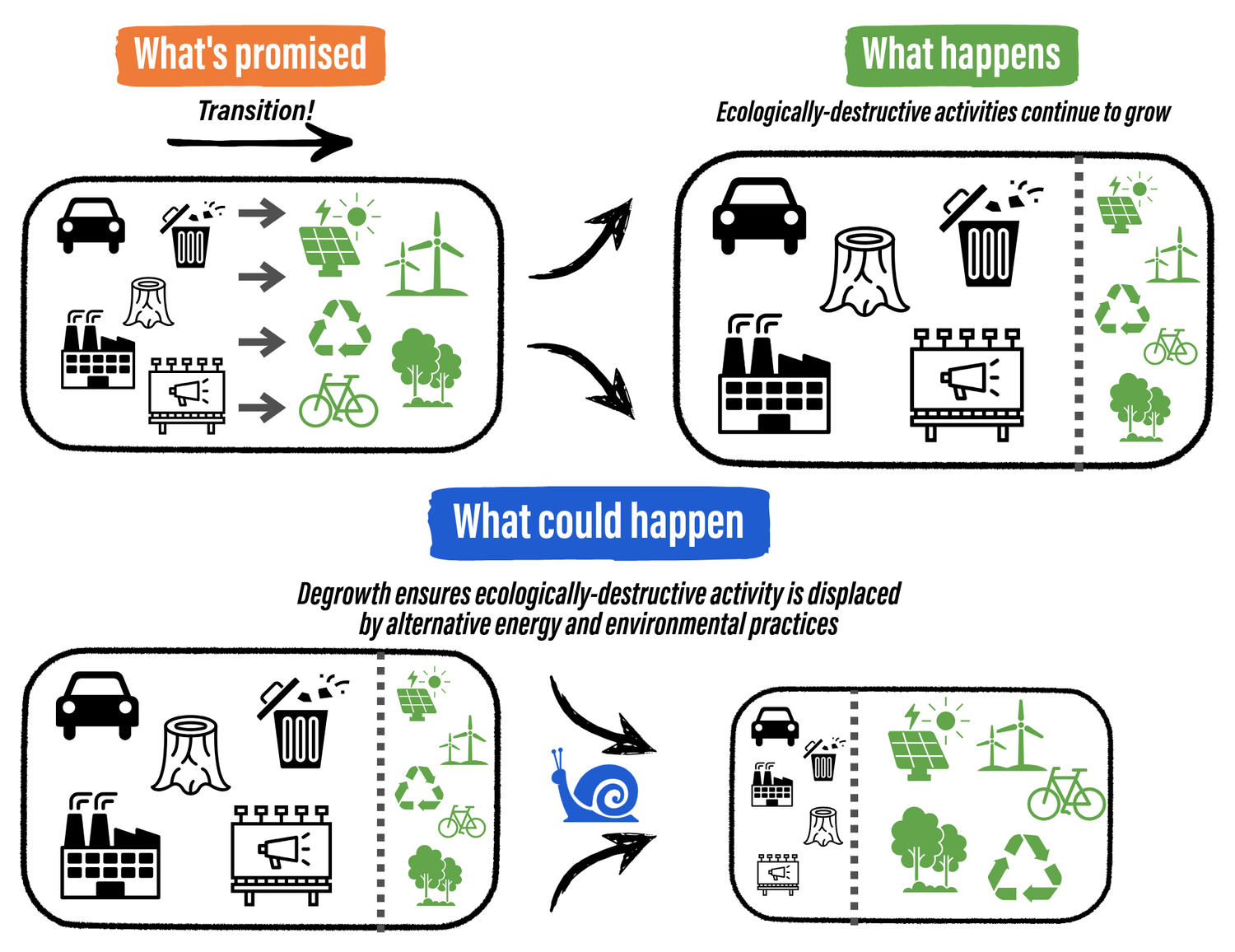
Figure 2
Continuous economic growth ignores the limits of our environment’s capacity to renew its resources and heal itself, and renders efforts towards sustainability ineffective [6]. Mainstream sustainability, the adoption of “green” technologies, and so-called “green growth” models have not successfully reduced greenhouse gas emissions or meaningfully improved the health of degraded ecosystems [7]. For example, the expansion of renewable energy sources such as solar, wind, and hydropower is viewed as a key strategy for climate change mitigation. However, research has shown that clean energy deployment has not resulted in a global reduction in fossil fuel use. Fossil fuel use continues to grow, as our global demand for energy keeps growing faster than “clean” energies can be deployed (Figure 2) [8].
In order to meet the multitude of challenges we currently face, we need to take the question of economic downscaling seriously, creating a smaller economy that prioritizes meeting the needs of people and the planet. This is called degrowth.
The US economy has overwhelmingly benefited from global economic growth since the industrial revolution, and positioned itself as one of the strongest players within the global economy since World War II [9]. As the world’s largest economy and one with disproportionate political influence on the global stage, the United States is arguably the most important context in which to implement a degrowth agenda. Not only is the transition of the U.S. economy towards degrowth important for global justice and wellbeing, but it can also help alleviate many of the social, ecological and economic challenges we face within our borders.
Essential services such as healthcare, education, public transportation, and housing are severely lacking for many Americans. However, it is possible to make these resources available to everyone, as is done in many other countries with far fewer resources than the US. In order to successfully fix many of the social and environmental issues we currently face, transitioning our economy is essential, and such a transition must carefully focus on shrinking harmful and unnecessary industries while supporting ones that improve human health and wellbeing.
Ultimately, it is the combination of global economic downscaling with a tangible shift in our economic structure and priorities that allows for a future where our economies do not destroy our life-supporting ecosystems. Resource-intensive, highly-polluting and socially harmful areas of the economy can all be reduced to shift resources towards meeting real human needs within planetary boundaries [10]. The economy as a whole can be brought under greater democratic control, where workers, communities and the public have meaningful control over economic decisions and can shape the economic realities that directly affect them [11]. Ecosystems can be restored, land use and industrial practices changed, and methods of production adjusted to build economies where human and ecological needs are mutually supportive [12]. Much of this work will need to be done in a way that strategically changes the structure of the very systems that exist within our country--through changes in policy that ripple outwards to support changes in daily behavior and mindset.
2. Achieving Degrowth Through Policy
As with any social movement, there are many strategies available to degrowth advocates working to build a just and ecological future, such as launching awareness and education campaigns, creating local initiatives, changing consumption habits, engaging in protest and civil disobedience, and organizing communities at the grassroots, to name only a few. While each of these efforts can be transformative in its own right, grassroots or educational campaigns struggle to quickly shape the way governments deploy resources in the immediate future. Therefore, shifting public policy is an essential part of making, and solidifying, social movement gains [13].
Building a degrowth policy agenda is a crucial part of transforming the economy and society, especially at a time when the policy landscape is dominated by market-led solutions that fail to address complex crises such as ecological overshoot, social shortfall, and global inequality. Despite the increase in corporate power and control, the state is still largely regarded as the provider of social protection and the guarantor of its citizens' collective interest.
Currently, the US government largely frames economic growth as a critical part of its responsibility, operating under a belief that individual and collective flourishing is best achieved through distributing the benefits brought by a growing economy. However, as argued above, economic growth is far from the best or only way to create a flourishing society. Instead, state institutions can be repurposed to directly promote human and non-human wellbeing, all while reducing economic size [14]. Policy advocacy is therefore an essential pathway to reorganizing the US, and global, economic system [15].
There is no single “degrowth” policy that can be crafted to fix the failures of our current social, environmental, and health policies (failures that are partly due to their tight reliance on endless economic growth.) Similarly, not all political strategies that challenge growth-centrism are labeled as “degrowth” policies. As such, this document seeks to build a comprehensive policy agenda, focused on reforms that change the overall balance of economic and political power.
While each policy taken individually only represents a partial success, introducing a suite of degrowth reforms can help transform the entire system [16]. Our present task is to build a coherent agenda with a clear overarching goal: building an economy that meets the real needs of people and the ecological systems we depend on for survival.
3. Characteristics of Degrowth Policy
Degrowth-aligned policies aiming to transform our economy come in various forms, yet they hold certain foundational principles:

Common purpose: Regardless of their specific area of focus, degrowth policies fundamentally contribute to an intentional downscaling of economic activities on a macro-scale, either by phasing out socially harmful and ecologically unsustainable goods and services, or substituting practices that maximize quality of life while minimizing energy and resource use.

Democratic design and implementation: In order to produce just and equitable outcomes, degrowth policies must be democratic in their design, meaning that those impacted by these policies have an equal opportunity to help design, shape and alter them through direct participation. These processes should center those who would be impacted most, and operate across levels and contexts (e.g. through citizens’ assemblies, participatory budgeting, worker’s assemblies, etc.).

Wellbeing and equity as priorities: Degrowth policies must be designed to uplift and support vulnerable communities while transforming the overall economy. For instance, plans to scale down carbon-intensive industries must include complementary measures to compensate the workers and communities that currently depend on such industries for their livelihoods, as well as policies that aim to redistribute wealth by taxing excessively rich individuals and companies.

Coherence across policy areas and layered policy agendas: Reorganizing the economy effectively requires a suite of interlocking policies operating across the national, state, and local scales. Accounting for synergies and contradictions at different levels is therefore key. Likewise, layered policy-making is crucial in dealing with complex crises. For example, instituting a wealth tax on the ultra-rich could be paired with mandatory fiscal contributions for emigrants, so wealthy individuals cannot simply leave the places in which they made their wealth without contributing to the local community.

Context-specificity: Degrowth policies have one overarching goal: ensuring the global economy meets human needs within planetary boundaries. However, social and ecological needs can be calculated at the level of individual countries or cities too. This means that degrowth transitions will differ in composition, scale, and speed depending on where and when they happen.

Maintaining a connection to the global scale: When designing policies aiming to reduce or re-localize production, it is crucial to avoid outsourcing the impacts in one location onto another (a process called externalization). Without considering the global economy, shifting economic activities in one location does not necessarily bring about an overall reduction in extraction and environmental impact. The global consequences of each measure must be at the core of policy design.

4. Basics of US Policy and Governance
To combat the impacts of the growth imperative across the US and around the world, the US needs a coherent, multi-sector degrowth policy agenda operating at multiple levels of government.
Different scales of policy intervention are required for different aspects of degrowing the US, and global, economies. The US has several layers of government responsible for making decisions over the same territory, primarily divided (of course) into the federal government and state governments. The US also has local (county and municipal) governments and tribal governments, which have their own spheres of influence and their own limitations (see Table 1). For instance, developing a municipal tool library or planting food forests on city park lands to reduce imports and consumption will necessarily require a different scale of governance than curbing the size and budget of the US military [17, 18].
All scales of intervention are important to fostering degrowth, just as degrowth requires both global economic downscaling and more local shifts in our livelihoods and lifestyles.
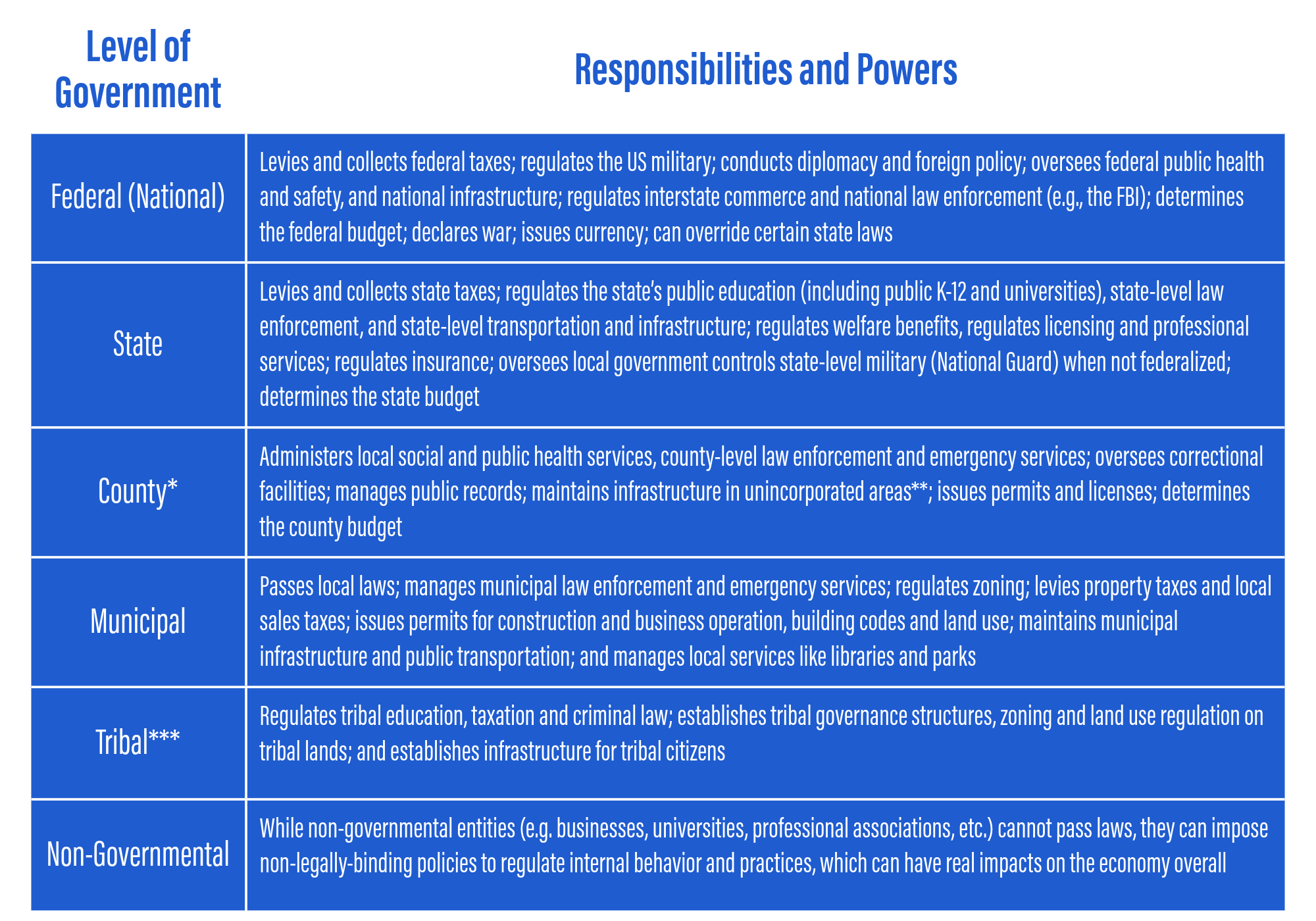
Table 1
*Counties are called “parishes” in Louisiana and “boroughs” in Alaska.
**Unincorporated areas are places in a county not included in a municipality.
***Tribal law in the United States is extremely complex. Tribal governments represent Indigenous Americans, and have a complicated legal history, as Indigenous societies obviously predate European settlement and the establishment of the US as a nation. While most tribal governments generally have similar functions to municipal governments, they are not created or regulated by state governments, and have the power to override some state laws. State governments, and even the federal government, have limited capacity to override tribal governments, as negotiations between the US government and federally recognized tribes are rooted in treaties that uphold tribal sovereignty, though the US has frequently violated tribal sovereignty rights throughout history [19].
Ultimately, intentionally downscaling the US economy and realigning its priorities to support ecological sustainability and social justice will involve policy intervention at all of these levels. Understanding what kind of intervention is needed, and at what level, is integral to the ultimate efficacy of this transition.
Some key questions to guide degrowth policy advocacy are:
What kind of intervention are you trying to make, and what scale of policy-making handles those sorts of changes? Does the intervention contribute tangibly to supporting human and ecological wellbeing?
What level(s) of policy do you have the ability to influence, and what interventions are possible at those levels?
What groups would be most affected by this intervention, and what are their desires and needs?
Because degrowth policy goals overlap with the goals of many other social movements (such as the environmental, labor, Indigenous sovereignty and economic democracy movements), building and organizing coalitions with other movements can expand the scale of policy that degrowth advocates can affect.

5. US Degrowth Policy Goals and Proposals
Note: the policy proposals listed here were the product of the research, discussion and ongoing deliberation by members of the Working Group. There has already been ample disagreement within that group on which policies are most important or which do or do not constitute effective degrowth policies, and we would like to encourage further debate and deliberation by anyone who engages with this document.
This section outlines some important policy ideas for the US to help bring about an intentional downscaling and just transition of the global economy. It is far from a definitive list, and it does not touch on every area where policy change could drastically improve quality of life for people living in the US and around the world. Likewise, as mentioned in Section 3, degrowth policy is ideally democratic in design and implementation, and the communities most affected by a policy need a voice in all decisions about them.
The following policy proposals are organized around ten goals of the degrowth movement. These goals are not ordered in terms of importance, as a degrowth policy agenda necessarily requires a multi-layered, multi-sector approach.
The identified goals are as follows:
Removing economic growth as an explicit policy goal, and shifting measures of economic success
Reducing social and economic inequality by building a robust social safety net that meets human needs
Shifting to more ecological, place-based methods of production
Increasing environmental protections and restoring degraded ecosystems
Encouraging resource sharing and reuse
Democratizing the financial system
Expanding popular control over the economy and reducing privatization
Supporting the sovereignty of Indigenous communities
Curbing the scope and budget of the US military
Reducing the domination of the global economy by US economic interests
The implementation, and the impacts, of the policy proposals below will inevitably take time. Some policy proposals, such as a ban on ecologically-destructive extraction, would have an immediate impact on ecological health, whereas others, such as establishing robust Rights of Nature, would lead to changes and improvements over time. Likewise, some policy proposals, such as restricting chain businesses in certain cities, have already been implemented in numerous places across the US and may be fairly easy to rally public support for, while others, such as enacting a federal universal basic income, would likely prove a longer and more difficult political battle.
As outlined in Section 2, our goal is to lay out a suite of potential reforms that, when enacted together, could dramatically shift the US (and global) economy towards meeting real needs with less consumption, and expanding public power to influence economic decisions.

Removing economic growth as an explicit policy goal, and shifting measures of economic success
The US government currently holds economic growth as an explicit policy goal [20]. Typically, economic “success” is measured by increases in Gross Domestic Product (GDP), a measure of the total economic value of goods and services produced over a period of time. GDP only measures the quantity of economic activity, not its quality; it includes many harmful factors that increase resource extraction, and does not factor in the wellbeing of people or the rest of our ecosystems [21]. For example, GDP characterizes a flood that destroys thousands of homes (and results in a lot of money spent on emergency medical services and re-building livelihoods) as “productive” even though the effects on people’s lives are generally negative [22]. Thus, it is essential to shift our policy goals away from measures that are blind to quality of life to ones that prioritize wellbeing, as well as gear policy towards establishing a steady-state economy (one with a stable level of resource use over time).
Key Proposals
-
Gross Domestic Product (GDP) is the primary means used to measure economic success, but it only calculates economic size, rather than looking critically at whether and how the economy is meeting human needs. Moving away from GDP as a measure of prosperity opens the door to other understandings of economic “success” and deprioritizes growth as a primary goal.
-
Measuring economic success in terms of the population’s wellbeing and ability to meet its basic needs gives a much clearer picture of how the economy is serving society. Many alternative measures of economic success have already been proposed around the world [23]. Since any effort to reduce evaluation to a single figure is likely inadequate, a dashboard of competing priorities might be most appropriate, which must be guided through public input and direct participation.
-
Currently, many local and state governments, as well as the US federal government, have economic growth as a stated policy goal and commitment. Turning this goal on its head, by making downscaling a goal, instructs economic policy to prioritize human and ecosystem health and wellbeing over economic size.

Reducing social and economic inequality by building a robust social safety net that meets human needs
Our current economic system prioritizes profits for the few over stable, dignified livelihoods for the many. Within this system, scarcity is often artificially created for the sake of continued profit growth, forcing people to purchase the goods and services needed to live with dignity (such as education, healthcare, housing, transport, food, energy and water). By removing this artificial scarcity and providing a stable baseline of income and services for everyone, we can provide decent living conditions for all without continued economic growth. Targeting structural inequalities in service provision further helps address race and gender inequalities and their corresponding barriers to accessing basic needs.
Key Proposals
-
A job guarantee aims to end unemployment and job precarity by offering part-time or full-time work to all those who seek it, paid at a living wage: a wage level that allows for a decent and dignified standard of living [24]. Such a program would provide meaningful job opportunities in socially- and ecologically-useful activities that need support (e.g., public transport, renewable energy, ecological restoration, etc.) while also shifting our productive capacities away from harmful extractive sectors. Retraining workers from fossil fuel industries and supporting their transition to public works or ecological restoration must be a core component of a job guarantee program, as well as an essential step in a just social-ecological transition.
-
Universal basic services (UBS) enable people to live decently by providing free or low-cost healthcare, childcare, education, housing, nutritious food, public transport, and internet to everyone. Recognizing these as rights rather than commodities serves to reject the imperative to grow, since people will have access to them without needing ever-increasing levels of income. Complementary measures are necessary to the realization of a UBS program:
Allocate UBS program funding at the state level: A federal UBS framework should be adapted to regional contexts and supported by state governments through subsidies to publicly-owned service providers.
Allow local governments to determine the precise nature of local public service provision: The types of goods and services needed, and the best way to distribute these equitably, differ from place to place. Ensuring that local residents participate in the planning, ownership, and provisioning of these public services is key to effectively implementing context-specific UBS.
Center racial and gender equity in distribution of services: As services are distributed, special attention should be paid to long-standing disparities in access to services, especially along race and gender lines. Public services to underserved (typically racialized) communities, and services that increase gender equality (such as women’s healthcare and childcare services), should be prioritized.
-
A standard minimal income creates a “wealth floor” that is sufficient for everyone to live with dignity and access adequate material needs. An ideal arrangement for a universal basic income (UBI) would be that it supplements robust universal basic services in order to supply discretionary monetary resources that accommodate diverse needs in a given context.

Shifting to more ecological, place-based methods of production
Globalized production and the pursuit of endless growth have instilled a race-to-the-bottom mentality in our economies, where resources are extracted from the Earth in the highest quantities possible, and workers are paid as little as possible. This dynamic perpetuates economies where consumers have little power to check multinational corporations for abuses and little connection to the ecological systems through which their needs are met. Shifting to more ecological means of production, and producing goods in ways that are uniquely tailored to local contexts can foster real decision-making power within communities, giving the people tangible power to manage their own economies and connect more deeply and responsibly to the ecosystems that meet their needs.
Note: As with many aspects of a degrowth transition, the movement to shift towards more ecological, place-based economies owes its inspiration and leadership to Indigenous communities. We strongly recommend looking into and connecting with Indigenous-led campaigns and organizations focused on these goals.
Key Proposals
-
This would encourage local production and food distribution, allowing small-scale, local production to compete with (or replace) globalized markets for essentials like food, lumber, medicine and textiles. Local governments in particular can utilize existing public lands, such as parks and school district land, for food production, and can purchase or enact eminent domain over private land for the development of other production resources.
-
Subsidizing regenerative agriculture and sustainable forestry would economically support farmers and foresters who use land in ecologically-sustainable ways, helping them to be able to compete with (or replace) globalized extractive industry.
-
This would restrict the ability of “formula businesses” (also known as chain stores) to operate brick-and-mortar stores within the affected area, encouraging locally-owned businesses to develop and proliferate.
-
AI technology has expanded rapidly in recent years, bringing with it serious concerns about resource use, data ownership and labor rights. Going forward, AI product developers should be forced to demonstrate tangible benefits for social and ecological good, as well as a lack of environmental harm, in their products and their required infrastructure (such as data centers) before deployment would be lawful [25].

Increasing environmental protections and restoring degraded ecosystems
The economy is ecology: every unit of economic output relies on inputs of natural resources from the ecosystems we call home. Protecting our ecosystems, and restoring degraded ecosystems to healthier functioning, is essential both to curbing the practice of endless extraction and to sustaining an environment that can meet the needs of generations to come. Ecological restoration is critical, skilled work, and represents one of the few industries in the US that arguably needs to grow [26].
Note: Across the US and around the world, Indigenous leaders have been among the most ardent voices calling for environmental protection and ecological restoration. We strongly recommend looking into and supporting environmental campaigns and restoration work led by Indigenous organizers.
Key Proposals
-
The US has infamously refused to sign or withdrawn from multiple treaties around environmental protections and carbon emissions, and has stalled international negotiations towards climate change mitigation. This trend must be entirely reversed, with the US actively helping to develop international treaties that strongly curtail natural resource extraction and enact robust ecological protections, and leveraging its international power (if needed) to sway other Global North countries to enact similar measures.
-
Bringing an end to ecologically destructive industrial practices (such as fossil fuel extraction, including fracking, clearcut logging, the construction of new oil pipelines, mountaintop removal mining and open pit mining) would not only halt further destruction of our ecosystems through these methods, but help force a broader shift in industry away from rampant ecological destruction.
-
Establishing Rights of Nature, or granting legal rights to nature and natural features such as rivers or mountains, requires commercial and government decisions to include the wellbeing of natural ecosystems in determining the legality of land use [27]. However, declarations of nature’s legal rights often prove functionally meaningless when private property rights are allowed to supersede them. To be truly meaningful, the legal rights granted to nature must be constitutionally protected above private property rights.
-
Funding not only workforce development, but market development, for ecological restoration would direct public resources towards expanding the job market for ecological restoration and encourage restoration of degraded ecosystems.
-
Expanding ecological education for everyone can encourage understanding of, and therefore, respect and care for, the living Earth. Greater ecological knowledge can likewise encourage a culture of prioritizing reciprocity with the natural world, rather than one-sided extraction from it. Such education would also prepare future generations for ecologically-grounded jobs and lifestyles.

Encouraging resource sharing and reuse
Excessive production, consumption, and extraction of resources intensifies climate breakdown, increases pollution, and exhausts planetary systems that provide essential life-supporting materials, including water [28]. The world has vastly unequal patterns of consumption and distribution of material surplus, as Global North countries regularly export their waste to the Global South [29, 30, 31]. Mitigating these impacts requires shifting the scale and purpose of production, creating longer-lasting, reusable and shared goods, and redirecting waste and surplus toward socially and ecologically beneficial ends, rather than discarding them.
These policy interventions focus on reducing demand for excess production and creating waste management systems that reuse or repurpose materials as much as possible. Both of these efforts work towards a goal of decreasing extraction and ecologically-harmful waste, and shifting our systems towards ones where the waste that is created is as ecologically harmless (or beneficial) as possible.
Key Proposals
-
Resource caps limit the total amount of natural resources that can be extracted from a given area (which should be determined via ecological measures such as bioregion or watershed), often applied to resources such as fresh water or greenhouse gas releases. Expanding resource caps to include all ecological inputs to the economy, from lumber to metals to livestock, could drastically reduce ecological impacts and economic size, and help ensure local economic size stays within an ecosystem’s regenerative capacity.
-
Requiring companies to pay for the end-of-life disposal or recycling of their products; developing municipal recycling and repair facilities for electronics, appliances and machinery; and banning planned obsolescence are all examples of policies that could encourage reuse and repair of products. Ensuring that products are made to last would likely lead to lower production and consumption throughout the economy. The Right to Repair movement has been working to improve these laws throughout the US, but the landscape remains uneven [32].
-
Establishing publicly-funded “libraries of things” would create structural opportunities for people to share resources, especially those that are not practical for single-ownership or have long dwell times that often leave them unused for long periods of time (drills/hardware tools, washing machines, cars, designer clothing, etc.). Establishing repair hubs (and, simultaneously, making things easily repairable and/or harder to get rid of) would also encourage people to consume less and reuse more.
-
In the United States, travel is heavily dependent on private vehicle use, and public transportation in many parts of the country is severely limited. Dramatically increasing investment in public transportation, such as rail and buses, would not only provide a broader transportation safety net, but could disincentivize private vehicle use and incentivize greater reliance on shared transportation resources.
-
Ensuring materials are recycled and composted, and products are repaired, can dramatically reduce consumption and waste in the economy. Establishing and funding facilities to keep waste and products recycled locally also reduces international waste disposal, and could be paired with policies to incentivize product reuse and disincentivize planned obsolescence.
-
So much of the overconsumption in the Global North (and particularly the United States) stems from the way advertisements have socially engineered us to believe we need to buy products. Companies use advertisements to make people want things they don’t need. Without advertisements, people would likely only seek out items that are actually necessary for daily life.

Democratizing the financial system
Private finance has failed time and time again to adequately invest in social and ecological programs, as free public services are not profitable to a private corporation. Creating a financial system that responds to genuine public need, and over which the public has decision-making power, is essential to building an economy that prioritizes wellbeing. Monetary reform can be used to democratize the finance, ensuring that public money (government funds, including tax revenue) is created and used in a way that benefits human and non-human wellbeing. Such a financial system would not be dependent on economic growth for its continued survival. Achieving this goal might include expanding the amount of public money created and establishing a network of decentralized, not-for-profit institutions to locally administer funds [33, 34].
Key Proposals
-
When controlled by private banks or cryptocurrency firms, money creation serves profit rather than human and environmental needs. Prohibiting private banks from creating money to loan out at high interest rates prevents the concentration of capital into the hands of big financial players at the expense of everyday citizens through debt creation. Gaining control over private finance would also enable citizens to determine what gets funded: banks could be barred from giving out massive loans to destructive fossil fuel projects or for housing market speculation. Instead, through public institutions, funds can be directed towards local social and ecological projects that serve the community’s needs [35].
-
Local or state governments can set up public banks (financial institutions run by professional bankers with oversight from a community advisory board.) This supports democratically-led and context-specific financial governance: public authorities that direct investments towards democratically-approved sectors and projects (ecological restoration, care activities, public services, etc.). Transparency in governance is key: with the input of the community, state and community needs such will be made a priority [36].
-
The previous policy interventions must be paired with measures to strengthen public control over financial systems to make sure they work for the public good, put sustainability first, and support equity. In the case of public banks, democratic oversight is ensured through the designation of a community advisory board and through full public disclosure of decision-making processes.
-
Another complementary measure to supporting the creation of public money is progressive taxation. Aside from reducing income inequalities [37], tax structures that increase the tax rate as wealth increases limit the purchasing power of wealthy individuals, and open up opportunities for the public to use that excess wealth for projects that will benefit everyone. Progressive taxation also reduces inflation, ensuring that the expansion of government spending does not harm citizens by triggering massive price increases [38, 39].

Expanding popular control over the economy and reducing privatization
The past two centuries have given rise to an aggressive transformation of the material world, especially the natural environment, into commodities that can be bought, sold, and owned. The expansion of private and state ownership over ever-larger parts of the natural world has created incentives for governments, corporations, and individuals to extract economic value from them in ways that are ecologically unsustainable and socially unjust. Expanding what resources are held in the commons (collectively stewarded by the communities that rely on them) is essential to building forms of environmental governance that sustain ecosystems and the communities that depend on them [40].
Key Proposals
-
This would apply to resources such as public lands, water resources and water rights, utilities, libraries, public schools and universities, and other resources. The goal is also to create legal pathways for communities (neighborhoods, cities and towns, counties, even states) to buy back resources that were previously privatized.
-
Creating a commons trust would establish a permanent, federal fund (distributed to states) to support bringing more resources back into public ownership.
-
As part of enacting a broad, robust Rights of Nature program, private property ownership laws could also be rewritten to require attending to the needs of land and outlaw mistreatment or neglect of land, similar to pet ownership and anti-animal cruelty laws that appear in many states.
-
This would instruct chambers of commerce and local business development agencies to focus on incubating and developing democratic, worker-owned cooperatives (businesses where the workers own the business collectively and exercise control over the business through democratic processes, such as voting or direct deliberation).
-
Expanding the powers of citizens and elected officials to regulate the actions of corporations through citizen review boards ensures greater corporate accountability and responsiveness to public needs.
-
Corporate power is incredibly hard to check and curtail while politicians are beholden to corporate interests to fund their campaigns. Banning corporate contributions to both political campaigns and political action committees (PACs) would get big money out of politics and curb political corruption.
-
Data rights are essential to power equity in the digital age, and ensuring individuals have the right to their own data, as well as rights of refusal, gives enormous power back to the public that is currently held by corporations. As data is democratized, so too must AI models and products that rely on public data be open to public review and democratic process, and should be regulated as a commons under the collective ownership of the public.

Supporting the sovereignty of Indigenous communities
Colonial expansion has long been the driving force behind extractive economies, just as the promise of economic growth has driven colonization [41]. In the US and around the world, Indigenous communities have not only been at the forefront of resisting colonization, but of fighting for ecological protections and economies that center human and non-human wellbeing [42, 43]. Creating a degrowth future in the US requires reckoning with the legacies of colonization, learning from Indigenous communities and promoting the sovereignty of Indigenous peoples, as well as protecting and restoring Indigenous lifeways and cultures.
Note: If you are not Indigenous, defer to Indigenous leadership when working to support Indigenous sovereignty. Your role is to be an ally, accomplice, follower, and amplifier of Indigenous-led movements, not to decide for Indigenous peoples how to win their own sovereignty. The following proposed interventions are drawn from policy goals frequently voiced by Indigenous leaders and organizations, and is not an exhaustive or definitive list. Like all people, Indigenous people are not a monolith, and there remains a diversity of priorities, goals and strategies for reestablishing sovereignty within Indigenous communities today.
Key Proposals
-
This would help to return land to Indigenous communities, and restore jurisdiction, economic independence, culture, and environmental leadership to the communities that have cared for their lands for millennia [44].
-
Requiring free, prior and informed consent (FPIC) and making it legally binding would expand the requirements for tribal governments to consent to decisions and proposed projects that impact their lands, and treat tribes rightly as governing nations with decision-making authority and veto power [45].
-
This would affirm tribes’ self-governing power over their lands and citizens, and reduces federal and state jurisdiction over tribal affairs [46, 47].
-
Policies increasing Indigenous authority over land stewardship would help to return functional Indigenous sovereignty over traditional territories and embed Indigenous land stewardship into environmental management [48].
-
Shifting federal funding for tribes from discretionary funding into mandatory funding would rightly treat tribes as sovereign governments, rather than program beneficiaries, allowing for greater tribal financial autonomy and strengthening long-term self-governance capacity [49].

Curbing the scope and budget of the US military
The United States Department of War (formerly the Department of Defense) is one of the largest institutional polluters in the world, generating greenhouse gas emissions greater than those of most countries [50]. The US alone accounts for more than 40% of global military spending, and nearly half of US federal discretionary spending goes to military-related activities [51]. Furthermore, the gradual privatization of national defense in the US has created a “military-industrial complex,” in which high defense spending and global military operations are promoted in ways that serve corporate economic interests (often more than they serve national security) [52]. It is no exaggeration to say that the US military is as responsible as US corporations for propping up the global economic status quo. Therefore, curbing its scope is essential to undoing the power of the growth imperative globally. Likewise, reducing military spending would free up hundreds of billions of dollars in the federal budget that could be spent expanding social services and restoring our ecosystems.
Key Proposals
-
The Pentagon’s annual budget sits at nearly $1 trillion, far exceeding military spending by any other nation [53]. Even the conservative Cato Institute argues that military spending far exceeds what’s necessary for national defense and should be drastically reduced [54]. Cutting the bloated military budget would free up billions of dollars for investment in public services and ecological restoration.
-
The US-based war industry has exploded, both in size and in ecological impact, due in large part to the awarding of defense contracts to private defense contractors [55]. Ending the privatization of national defense is critical both for restoring public oversight and for decreasing the scale of US defense operations.
-
The US military operates over 750 international bases in over 70 countries, far exceeding the international operations of any other military [56]. The operation of these sites is not only hugely expensive, but military operations on these sites are often entirely unregulated in terms of their ecological impacts or greenhouse gas emissions [57]. Closing these bases would not only curb the ecological impacts of the US military and reduce the overall military budget, but help foster a world with greater national self-determination and less international domination by US interests.

Reducing the domination of the global economy by US interests
The US is not just the world’s largest economy; it structurally dominates the global economic system. Because the US dollar serves as the world’s primary reserve and trade currency, and because the US has outsized influence in international financial institutions that keep many Global South nations trapped in austerity and debt, the US has exceptional financial leverage over economies around the. world [58, 59]. Add to this the global reach of US-based multinational corporations, and the global dominance of the US military (which protects trade routes and US investments abroad), and it’s no exaggeration to say that the current global economic status quo is primarily perpetuated and enforced by the United States.
At the same time, US economic dominance on the global stage does not equate to a better quality of life for the majority of people domestically. Most wealth this system generates remains in the hands of a small number of multinational corporation shareholders and financial institutions, while real wages and economic power continue to decline for the majority of Americans [60]. Shifting global economic power and trade is essential not only for bringing an end to endless economic growth globally, but for creating a domestic economy that meets the real needs of the American people.
Key Proposals
-
Taxing US corporate activity abroad would reduce the incentive for US companies to engage in offshoring (exporting jobs and production abroad), while raising domestic federal revenue for social services.
-
Breaking up big corporations through stronger antitrust legislation would curb the national and global dominance of US corporations would lead to more distributed economic power and less ability for corporations to act without checks and regulation.
-
The US economy is rife with speculation, or stock market gambling on potential outcomes. Speculation can destabilize the economy, cause recessions, and adds no real value to the economy, making markets less volatile. Taxing and regulating speculation would likely dramatically reduce its prevalence and curb its impacts on the economy overall.
-
Pulling the US back from controlling international financial institutions such as the International Monetary Fund and World Bank lowers the risk that taxpayer money is used to bail out other countries or cover bad loans, and encourages greater economic sovereignty and financial wellbeing for the Global South.
6. Conclusion: Where Do We Go From Here?
This document is meant to serve as a brief introduction to different US-based policies, at multiple scales, that could support global economic downscaling. It is best used as a starting point for those interested in organizing around degrowth goals to orient themselves in their degrowth advocacy work and in navigating the many dimensions of a degrowth transition. It is also, as we’ve reiterated, intended to spark conversation and debate, not to be a final or definitive statement on degrowth policies.
So far, we’ve focused on the Why and the What of degrowth policy advocacy in the US. This conclusion offers a preliminary discussion of the How.
In Section 4, we noted a few key questions to guide your degrowth policy advocacy work:
What kind of intervention are you trying to make, and what scale of policy-making handles those sorts of changes? Does the intervention contribute tangibly to supporting human and ecological wellbeing?
What level(s) of policy do you have the ability to influence, and what interventions are possible at those levels?
What groups would be most affected by this intervention, and what are their desires and needs?
The answers to those questions may not always be obvious, and may require careful consideration and collective discussion to reach. There are many dimensions to a degrowth transition, and many different ways to engage in advocacy around each. Likewise, doing the work of policy advocacy involves many different strategies, from passing ballot initiatives and petitioning elected officials, to education, community organizing, culture change, content creation, and direct action.
The more you get to know the political landscape, decision-makers, and stakeholders where you live, the more equipped you will be to make political change. The US is already rich with organized advocacy groups and social movements focusing on any and all of the goals outlined in Section 5, though many of these movements may not use the term “degrowth” at all. Likewise, many existing groups already represent key stakeholders and impacted groups.
Thus, it’s also helpful to familiarize yourself with existing allied movements. You might find shared policy goals in organized movements for environmental justice, just transition, localism, bioregionalism, slow living, economic democracy, the solidarity economy, the wellbeing economy, demilitarization, Indigenous sovereignty, democratic socialism, and anti-imperialism. We especially encourage you to look towards movements, campaigns, and actions led by Indigenous communities. Many of the most important conversations around environmental, social and economic transformation are Indigenous-led, and the degrowth movement as a whole owes a debt of inspiration and thought leadership to Indigenous communities in the US and around the world.
At the same time, continuing to embrace and discuss degrowth principles with your community spreads awareness, deepens knowledge and expands the possibilities of what we can achieve. The more familiar people are with these ideas, the less radical they will seem, and the more politically feasible they will become.
If you’re interested in putting these ideas into practice, here are some first steps:
Familiarize yourself with the political landscape where you live. Who are the key decision-makers in government? What interests are they beholden to? Who is challenging them? How are decisions made in your local and state government?
Learn about, and build relationships with, the activists, organizers and social movements in your area. Who is already doing the work of social change? Are any of them focused on degrowth-aligned goals? What support do they need?
Choose policy priorities to focus your advocacy efforts on, based on your community’s unique context. As mentioned, partner with other organizers and groups when needed or helpful.
Identify the strategies needed to pass your policy proposals. Is the proposal politically viable enough to pass as a ballot measure in the current environment? Are there representatives or candidates open to degrowth-aligned goals? Or is more work needed to shift public perception and opinion through grassroots organizing, education or direct action?
Keep discussing, writing about, debating and amplifying the message of degrowth. For many people, an alternative to our current system is difficult or impossible to imagine. You never know what inspiration or paradigm shift you might catalyze simply by discussing what a degrowth future could look like in your community. For help with launching degrowth discussions, check out DGI’s Degrowth Organizing Toolkit.
Share your experiences with others in the degrowth movement. What has worked for you? What have your struggles been? There are people all across the US and around the world interested in putting degrowth principles into practice, and the more we share information with one another, the stronger our movement will be.
Ultimately, achieving a degrowth transition in the US will require a multifaceted, multi-level approach, and it will not happen all at once. Policy advocacy is only one of many strategies towards implementing degrowth, and it too should not be pursued in a vacuum. Degrowth is a movement, and achieving degrowth will take a movement. None of us can downscale the global economy on our own, but we can work with others to make small, tangible changes with large, sweeping impacts.
-
[1] Bolotsky, J. et al. Use Your Radical Fringe to Move the Overton Window. Beautiful Trouble https://beautifultrouble.org/toolbox/tool/use-your-radical-fringe-to-shift-the-overton-window (2013).
[2] Mulrow, J., Barahona Rosales, J., & Prouty, A. Has the Economy Outgrown the Planet? Degrowth Institute https://www.degrowthinstitute.org/challenge-growth01 (2025).
[3] Stockholm Resilience Centre, Stockholm University. Based on Sakschewski and Caesar et al. 2025, Richardson et al. 2023, Steffen et al. 2015, and Rockström et al. 2009 https://www.stockholmresilience.org/research/planetary-boundaries.html (2025).
[4] Mulrow, J., Dahmm, H., Barahona Rosales, J., & Prouty, A. What Happens to the Savings? Degrowth Institute https://www.degrowthinstitute.org/challenge-growth02 (2025).
[5] Hickel, J. The anti-colonial politics of degrowth. Resilience. (2021)
[6] Jackson, T. Prosperity Without Growth. (Earthscan, London, 2009).
[7] Vogel, J., & Hickel, J. Is green growth happening? An empirical analysis of achieved versus Paris-compliant CO2–GDP decoupling in high-income countries. Planetary Health 7, doi:10.1016/S2542-5196(23)00174-2 (2023)
[8] Parrique, T., Barth, J., Briens, F., Kerschner, C., Kraus-Polk, A., Kuokkanen, A., & Spangenberg, J. H. Decoupling debunked: Evidence and arguments against green growth as a sole strategy for sustainability. European Environmental Bureau. (2019)
[9] Council on Foreign Relations. How Did the United States Become a Global Power? (2026).
[10] Cox, S. Anthropause: The Beauty of Degrowth. (Seven Stories Press, New York, 2026)
[11] Akbulut, B., Adaman, F. The Ecological Economics of Economic Democracy, Ecological Economics 176, 106750. (2020).
[12] Kimmerer, R.W. The Serviceberry: Abundance and Reciprocity in the Natural World. (Blackstone Publishing, Ashland, OR, 2024).
[13] Berglund, O., Dunlop, C. A., Koebele, E. A., & Weible, C. M. Transformational change through Public Policy. Policy and Politics 50, 302–322. (2022).
[15] Schneider, C., Hofferberth, E., Barth, J., Hardt, L. Paving the way for post-growth policy-making: A co-creative process to advance the degrowth movement. (2019).
[16] Schmidtner, D. Non-reformist reforms as transformation strategy for the
degrowth movement. Momentum2024. (2024).
[17] St. Louis, MO Government. Establish a Community Tool Library. Sustainability Toolkit.
[18] Glenn, S. Food forest at Charlotte’s Blueberry Park has expanded. Parks Tacoma. (2025).
[19] U.S. Department of the Interior. Frequently Asked Questions. Indian Affairs.
[20] Underwood, A. The Economic Priority of the Seven Wealthiest Countries: More Wealth. Steady State Herald. (2024).
[21] Fioramonti, Lorenzo. Gross Domestic Problem: The Politics Behind the World’s Most Powerful Number. (Zed Books, London, 2013)
[22] Killelea, S. The Problem with GDP. Peace in the Age of Chaos: The Best Solution for a Sustainable Future. (2022).
[23] https://intheblack.cpaaustralia.com.au/economy/8-ways-of-measuring-economic-health
[24] Living Wage For US
[25] https://aiplanetaryjustice.com/publications/a-degrowth-perspective-on-ai
[26] Levelt, L., Chevrollier N., & Argyrou A. Regeneration, sufficiency and degrowth: an integrative review of organising in a strong sustainability era. Sustainability Science 11. 753–775 doi:10.1007/s11625-025-01760-1. (2026).
[27] Surma, K. What Are The Rights of Nature? Justice & Health, Inside Climate News. (2025)
[28] Friends of the Earth. Consumption: Natural Resources. https://friendsoftheearth.uk/consumption-natural-resources
[29] Volner, I. The Dirty Little Secret Hiding in Your Garbage Can. NYTimes. (2025).
[30] https://www.ft.com/content/6545b937-3600-4674-a7e3-6bc60aff2c4d
[31] https://www.ban.org/news-new/2021/4/20/the-global-norths-environmental-impact-on-the-global-south
[32] https://www.repair.org/stand-up
[33] linkinghub.elsevier.com/retrieve/pii/S0921800923002318
[34] https://www.mdpi.com/2071-1050/5/6/2802
[35] https://mail.cadmusjournal.org/files/journalpdf/Vol4Issue4/Vol4_Issue4.pdf#page=125
[36] https://publicbankinginstitute.org/public-banks-101/
[37] https://gabriel-zucman.eu/files/saez-zucman-wealthtaxobjections.pdf
[38] https://www.pgpf.org/article/how-can-fiscal-policy-help-reduce-inflation/
[39] https://www.sciencedirect.com/science/article/pii/S0921800923002318?via%3Dihub
[40] Bollier, David. Think Like a Commoner: A Short Introduction to the Life of the Commons. 2nd ed. Gabriola Island: New Society Publishers, 2025.
[41] https://polsci.institute/comparative-politics/economic-foundations-of-colonialism/
[42] Dina Gilio‑Whitaker, As Long as Grass Grows: The Indigenous Fight for Environmental Justice, from Colonization to Standing Rock (Beacon Press, 2019)
[43] James V. Fenelon & Leonardo Figueroa Helland, Global Indigenous Struggles and Climate Change Activism (in The Oxford Handbook of Climate Action, 2025)
[44] https://ndncollective.org/landback/
[45] https://un-declaration.narf.org/wp-content/uploads/tip-fpic-guide2025.pdf
[46] https://www.ncai.org/section/policy/portfolios/legal-and-governance
[47] https://www.ncai.org/section/policy/portfolios/public-safety-and-justice
[48] https://www.firstnations.org/projects/environmental-sovereignty-and-justice/
[51] https://www.pgpf.org/article/chart-pack-defense-spending/
[52] https://www.thenation.com/article/world/military-industrial-complex-defense/
[53] https://www.pgpf.org/article/chart-pack-defense-spending/ again
[54] https://www.cato.org/downsizing-government-essay/plan-cut-military-spending?utm_source=chatgpt.com
[56] https://www.politico.com/magazine/story/2015/06/us-military-bases-around-the-world-119321/
[57] https://fpif.org/overseas_military_bases_and_environment/
Got Feedback?
This is intended to be a living document, consistently edited, revised and improved through feedback and further discussion. If you have thoughts and feedback to share, please fill out the contact form below. If you’d like to be involved in drafting further revisions to this document or future policy documents, consider joining the Degrowth Policy Working Group!

US Degrowth Policy: The Basics © March 2026 by Degrowth Institute is licensed under CC BY-SA 4.0
Corresponding Author: Anna Prouty
Contributing Authors: Rubaina Anjum, Andy Bruno, Matthew Burke, Lily Edelman-Gold, Milena Hanenberg, Anna Prouty
Conceputalization: The Degrowth Policy Working Group, Degrowth Institute, Leadership for the Ecozoic
Design and Layout: Anna Prouty